Total Pageviews

Thursday, January 27, 2022

History of Electricity Uses

The first practical application of electricity was the telegraph, invented by Samuel F.B. Morse in 1837. The need for electrical engineers was not felt until some 40 years later, upon the invention of the telephone (1876) by Alexander Graham Bell and of the incandescent lamp (1878) by Thomas A. Edison. These devices and Edison’s first central generating plant, in New York City (1882), created a large demand for people trained to work with electricity.

Electrical phenomena attracted the attention of European thinkers as early as the 17th century. The most noteworthy pioneers include Ludwig Wilhelm Gilbert and Georg Simon Ohm of Germany, Hans Christian Ørsted of Denmark, André-Marie Ampère of France, Alessandro Volta of Italy, Joseph Henry of the United States, and Michael Faraday of England. Electrical engineering may be said to have emerged as a discipline in 1864 when the Scottish physicist James Clerk Maxwell summarized the basic laws of electricity in mathematical form and showed that radiation of electromagnetic energy travels through space at the speed of light. Thus, light itself was shown to be an electromagnetic wave, and Maxwell predicted that such waves could be artificially produced. In 1887 the German physicist Heinrich Hertz fulfilled Maxwell’s prediction by experimentally producing radio waves.

Wednesday, January 26, 2022

Difference in Electrical and Electronics

 In terms of engineering, the distinction between electrical engineering and electronics is generally based on the relative intensity of the electric currents being used. In this sense, electrical engineering is the branch dealing with “high current” that can be referred to as, electric light and power systems and apparatuses. Whereas electronics engineering comes into effect with “light current” applications like wise telephone and radio communication, computers, radar, and automatic control systems.

Sunday, January 23, 2022

Electrical Engineering and sub-fields

 When we talk about Electrical Engineering and sub-fields we should also know the constituents of the same. It comprises of three sub fields i.e. Electricity, Electronics and Electromagnetism. Today Electronics Engineering and sub-fields has become so vast that it has been segregated from Electrical Engineering. It is again divided into numerous sub-fields which can be classified as Instrumentation, Digital Computers, Telecommunications, Microelectronics, RF Engineering, Power Engineering, Signal Processing and Control Systems

To study the various aspects of electrical and electronics an engineer needs a wide range of test & measuring instruments to analyze and practically visualize various characteristics and studies which have been taught during the course. Some of these widely used instruments are multimeter ( needed for measuring current, voltage and resistance), Oscilloscopes (used for time-varying signals), Spectrum Analyzers & Network Analyzers (study of Radio Frequency Engineering used in mobile phones, radios, Wi-Fi etc.). It is impossible to study of electrical & electronics engineering equipment without using these instruments.


Saturday, January 22, 2022

Digital and Analog Electronics Lab Equipment

 If we go a few decades before all the measuring instruments available in the market were analogue. So it was pointless to ask: Do I use an analogue measuring instrument or a digital measuring instrument? Today because of the efficacy of results in Digital Electronics measuring instruments it is always advisable to use them where precise measurements of values are required. If we talk about analogue measuring instruments I would like to tell you that they are not only senior but are also superior to digital ones. One factor where they come ahead is the “fidgeting” effect of a digital display which can be quite annoying during fine adjustment, because it is difficult to recognize digital trend weather the value is going up or down? An analogue pointer instrument is much easier to read and appropriate to identify the direction of movement. Moreover the movement of a pointer is more recognizable to the human eye if compared to constantly changing digital values. 

Friday, January 21, 2022

Flow of Electrons

The most familiar form of engineering in our daily lives is electrical egineering. In simple words, flow of electrons is called electrical energy. The branch of engineering which deals with producing, managing and utilizing this energy, is referred as electrical engineering. This field of electrical egineering was introduced in an organized manner in the mid of 19th century. Interest in this field of study grew after the invention of electricity. It was June 1752 when Benjamin Franklin first tried to catch electricity from clouds during a heavy storm with the help of a flying kite. That was the beginning, but today we have worked out and invented numerous was to tap this energy.


Tuesday, January 18, 2022

Electrical Engineering Equipment

 Our vast range of electrical engineering laboratory equipment include electrical appliance trainer, electrical circuit fault trainer, multi meter, clump meter, electric motor three phase, AC/DC converter etc. Our electrical engineering laboratory equipment include central control panels, cut models of machines lab, experimental setup panel boards lab, electronics circuits system lab, antenna satellite radar RF etc. The practical performed on this list of Electronics Lab Equipment is relative to the engineering theory being imparted in the classroom. Meticulous care is taken for designing List of Electronics Lab Equipment.

Thursday, November 19, 2020

Electrical Engineering Lab Equipment

Acumen Labware is a company of Indian origin based at Ambala, the city known for its Scientific Instruments across the globe. It was established in the year 2007. Our product line is wide, advanced and reliable, meeting the needs of various sectors like Institutes, Labs, Industries and others. Also, we focus on new products and up-gradation of our existing range to provide our clients the best possible Lab Solutions.

Our vast range of Electrical Engineering Lab Equipment caters to the needs of technical training institutes in India and around the world. From a quite a long time we have been undisputed leaders of manufacturing Electrical Engineering Lab Equipment  because of our constant up-gradation and evolution manufacturing process.


Thursday, June 4, 2020

Mechanical engineering lab equipment

Mechanical engineering is the study, design, development, construction, and testing of mechanical and thermal sensors and devices, including tools, engines, and machines. Mechanical engineering lab equipment focus on encouraging the thought process for creating technologies which meet a wide range of human needs.
Using mechanical engineering lab equipment they are taught to design everything from new batteries, athletic equipment to medical devices and from personal computers, air conditioners, automobile engines to electric power plants. These engineers also design machines that produce these innovations.

Thursday, April 30, 2020

Fluid mechanics lab equipment

https://acumenlabware.com/fluid-mechanics-lab/index.htmlFluid mechanics is a subject with almost endless ramifications, and the account that follows is necessarily incomplete. Some knowledge of the basic properties of fluids needed by engineering students and a survey of the most relevant properties can be attained by using our state of the art Fluid mechanics lab equipment.


Sunday, April 19, 2020

Chemical Engineering Lab Equipment

Chemical engineers are uniquely positioned to take advantage of the convergence because our curriculum emphasizes the translation of physical and chemical phenomena into processes at scale and this is done with the help of our new age chemical engineering lab equipment.

However, it would be hubris to believe that chemical engineers alone will make innovative manufacturing processes a reality — the roles of other engineering and scientific disciplines are equally vital, and embracing this multidisciplinary future will bring about the greatest advances. Therefore, to prepare ourselves to be a part of advanced manufacturing, we need to both strengthen our core and expand our periphery by using the most advanced chemical engineering lab equipment.

Monday, April 13, 2020

STEM education

Today as we all know the focus for education has shifted towards STEM oriented subjects globally. This shift has resulted in the surge of requirement for quality technical training equipment. Hence we at acumen labware are constantly following the endeavour to develope best in class equipment for

Tuesday, April 7, 2020

Electronics Lab Training Kits

The one stop shop for electronics lab training kits is acumen labware. You will be astonished to see the wide range of electronics lab training kits available with us. We have a proven track record of improving our designs and make on of the most advanced range of trainer kits available in the market.


Thursday, December 19, 2019

Physics lab list-2

Today we have upgraded three more physics lab equipment as described below:

  • Diode Laser Diffraction: This Experiment setup is used to study the diffraction phenomenon of light which can be observed when a laser beam passes through a diffraction slit. The intensity pattern can be determined using a pin photo detector with fine movement across the diffraction pattern. 


  •  Electrical Conductivity Of Metal: The electrical conductivity of a metal (Copper & Aluminum) is determined by the resistance R of the rod and its geometric dimensions (l=0.315 m, A = 4.91 x10⁻⁴ m2).


  •  Field Lines & Equipotential Lines: This Experiment setup is used to study the diffraction phenomenon of light which can be observed when a laser beam passes through a diffraction slit. The intensity pattern can be determined using a pin photo detector with fine movement across the diffraction pattern. In the present setup, the light intensity in the terms of current or voltage is noted at closed intervals by finely traversing the detector movement and observing the light intensity on a digital multimeter.


For more info on physics lab google: Acumen Labware.  

Wednesday, December 18, 2019

Physics Lab Equipment List


Some of our latest redesigned lab equipments for higher physics:

Balmer Series And Rydberg Constant: In this experiment set-up a discharge lamp is used to emit hydrogen atoms which form a series of lines in the visible part of the spectrum.

BH Curve Loop/ Magnetic Hysteresis Loop Tracer: In this experiment when a cylindrical sample is placed coaxially in a periodically varying magnetic field the magnetization in the sample also undergoes periodic variation.

Dielectric ConstantThe main objective of this experiment is to verify the relation between capacitance C, charge Q and charging voltage E which is given as C=Q/E. The capacitance of a parallel plate capacitor depends upon the distance d between the plates, area A of the plates and the nonconductive material (having dielectric constant) between the plates.

Friday, December 13, 2019

AL-E413 QUINCK’S TUBE EXPERIMENTAL SETUP


Quinck’s Tube Experiment is an instrument to measure of susceptibility of paramagnetic solution.

Experiment
To measure the magnetic susceptibility of FeCl3 solution by Quinck’s  tube method.

Apparatus Supply
  1.  ELECTROMAGNET - Made of soft iron, specially design for Quinck’s tube experiments, mounted on a wooden base for stable performance, Pole pieces :- 50mm dia. tapered type Field :- 7.5kg at 10mm. air gap,            Energizing Coils :- Two coils each with total resistance of       9 ohms (approx).
  2. DIGITAL POWER SUPPLY FOR ELECTROMAGNET - 0 - 6Amp, 60V digital display, It is a constant current power supply, with long time operation and continuously variable current.  
  3. DIGITAL GAUSS METER:   Range : 0-2 K Gauss & 0-20 K Gauss, Resolution: 1Gauss at 0-2 K Gauss Range, Accuracy: ± 0.5%, Display: 3 ½ Digit, 7 Segment LED, Power: 220V, 50Hz Special Feature: Indicates the direction of the Magnetic field.
  4. QUINCK’S TUBE WITH STAND: A Glass Tube with wooden stand
  5. SAMPLE: FeCl3 Solution
  6. TRAVELLING MICROSCOPE: Consists of cast iron base with machined V-shape  vertical pillar, microscope tube consists of 10x eye piece and an achromatic objective of 50-75 mm working distance, embedded stainless steel horizontal scale is graduated up to 17 cm and vertical scale 15 cm, vertical and horizontal slide can be clamped at any position using clamping screw, fine motion is brought about by micrometer screw, horizontal and vertical vernier of 0.01 mm are provided along with two leveling screws, packed in plywood box.

Thursday, December 12, 2019

Measurement of Susceptibility of Paramagnetic Solids by Gouy’s Balalnce Method.

Apparatus for Measurement of Susceptibility of Paramagnetic Solids by Gouy’s Balalnce Method. In the Gouy’s method of susceptibility measurement, the solid sample in the form of a long cylinder (area of cross section A) is hung from the pan of a balance and is placed such that one end of the sample is between the pole-pieces of the magnet (field H) and the other one is outside the field. The force exerted on the sample by the inhomogeneous magnetic field is obtained by measuring the apparent change ( m ) in the mass of the sample. The susceptibility is given by
= 2 mg/AH
If the sample is in the form of powder, it is filled in a long nonmagnetic tube which is then suspended from the pan of the balance.
The set up consists of the following:
(a) Digital Balance, CA-44
(b) Sample in the form of a long rod:
(c) Electromagnet, Model EMU-75T
(d) Constant Current Power Supply, Model DPS-175M
(e) Gaussmeter, Model Al-E-115
(f) GMX-02 Trolley, Model ALE-kH3
Capacity : 40gms
Readability : 0.0001gms
Repeatability : (+/-) 0.1mg
Linearity : (+/-) 0.2mg
Pan Size : 80mm
Standard bidirectional RS-232
interface
Complete with weigh below hook feature suitable for AL-E401 Gouy’s Balalnce Method measurement
Aluminium sample and Glass Tube
Pole Pieces : 75mm tappered to 25mm
Mag. Field : 20KG mm airgap
(specifications as per datasheet)
The experiment is complete in all respect.
Energising Coils : Two of approx. 13W each
Power : 0-90Vdc, 3A, for coils in series
0-45Vdc, 6A, for coils in parallel

Physics Lab Equipment

We are proud to announce the introduction of our totaly new and reinvented range of Physics Lab Equipment. With this latest product profile we expect our products will impact the learning ability and understanding of vast number of students. For more information please visit Physics Lab Equipment

Monday, April 15, 2019

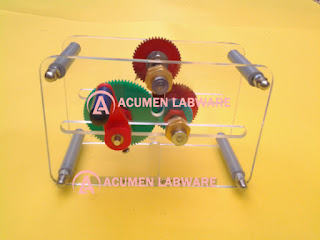
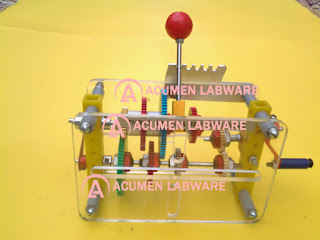
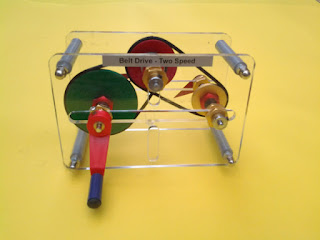
Mechanics Gear Models

We are very happy to inform our readers that we have introduced long waited mechanics gear models in our prodcut profile. Fore more details please mail us at acumenlabware@gmail.com.

http://www.acumenlabware.com/mechanical-models/belt-drive-toothed.html

http://www.acumenlabware.com/mechanical-models/belt-drive-two-stage.html

http://www.acumenlabware.com/mechanical-models/three-speed-&-reverse-gear.html

http://www.acumenlabware.com/mechanical-models/three-stage-spur-gear.html

Saturday, September 8, 2018

Laboratory Glassware

Our range of Laboratory Glassware includes almost all items required in general lab usage. Our expertise in melting and forming low expansion, chemically inert borosilicate glass for over 50 years has made our products preferred globally. Our apparatus for measurement of volumes rank amongst the most accurate in the world. When it comes to laboratory glassware equipment and lab glassware supplies for scientific laboratories, we are one of the largest manufacturer and suppliers.
With our breadth of products and depth of knowledge, AcumenLabware offers everything you need to streamline your workflow and simplify everyday life in many laboratory oriented disciplines. From a primary school teaching demonstration kit to a Quality Control Laboratory in a Pharmaceutical company,  Acumen Labware products can be easily found in every type of laboratory. Our products play an important part in many applications, whether preparing buffers or media, storing powders and solids or performing distillations and extractions, we have the products to suit your scientific need.